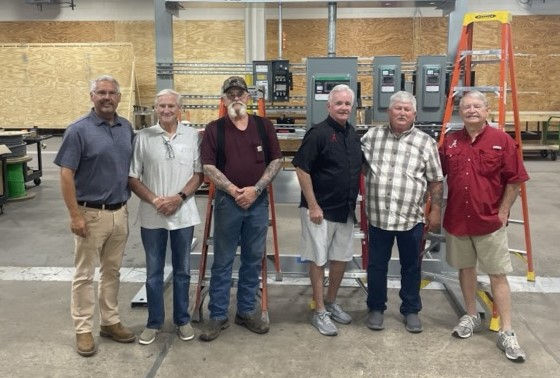
AGC CSPY Award goes to...
Leading With Purpose: Joey Flowers Named AGC’s Construction Safety Professional of the Year
By Nicole Needles

For Joey Flowers, safety is more than a program, a checklist or a compliance requirement. It is a responsibility shaped by service, leadership and an unwavering commitment to protecting people. That philosophy, cultivated over more than two decades in construction safety, has earned Flowers the AGC Construction Safety Professional of the Year (CSPY) award.
Presented annually by the Associated General Contractors of America, the CSPY award recognizes outstanding construction safety professionals from AGC member companies who demonstrate excellence in leadership, innovation, and measurable results. Reserved specifically for in-house safety professionals, the honor highlights individuals who have made a lasting impact on jobsite safety and safety culture across their organizations.
As Director of Safety, Training and Risk Management, Flowers exemplifies the purpose of the award: advancing construction safety not as a standalone initiative, but as a core organizational value that protects lives, strengthens teams and improves project outcomes.
A Foundation Built on Service
Flowers’ approach to safety leadership is deeply influenced by his background as a Marine Corps combat veteran. He served multiple deployments in Iraq and Afghanistan, where accountability, situational awareness and teamwork were essential to mission success.
“In the military, risk management isn’t optional,” Flowers said. “You learn quickly that preparation, communication and leadership directly affect whether people make it home.”
After leaving the Marine Corps, Flowers was introduced to the construction industry through a relative who owned a safety consulting firm, Safety Guidance Specialists. That introduction marked the beginning of a career spanning more than 21 years in construction safety.
Under the guidance of experienced mentors, Flowers was trained in construction safety while working closely with owners, general contractors and subcontractors on active jobsites. The exposure provided him with hands-on experience across a wide range of construction projects and environments, which proved invaluable early in his career.
“I was fortunate to learn safety in the field, not just in a classroom,” he said. “Seeing how real decisions affect real people changes the way you approach safety.”
Education and Professional Development
To complement his field experience, Flowers pursued formal education. He earned a bachelor’s degree in Occupational Safety and Health from Columbia Southern University, with coursework through the University of Alabama.
Over the years, he has continued to invest in professional development, obtaining numerous certifications that further strengthened his technical expertise and leadership skills.
His credentials include certifications through the University of Alabama, NCCER Master Trainer, OSHA and multiple additional industry-recognized programs. Together, his education, certifications and military background laid the groundwork for a career dedicated to improving jobsite safety and building strong safety cultures.
“That combination of experience gave me a long-term perspective,” Flowers said. “Safety isn’t about one project or one policy, it’s about protecting the workforce over time.”
Making Safety Part of the Work
Throughout his career, Flowers has focused on one guiding principle: safety must be embedded into daily operations to be effective.
“I’ve always believed that safety works best when it’s proactive and consistent,” he explained. “It shouldn’t feel like something separate from the job; it should be part of how the job gets done.”
Among the key initiatives Flowers has implemented are strengthened job hazard analyses and pre-task planning processes that encourage crews to think through risks before work begins. He has expanded hands-on, role-specific training to ensure employees understand not only the rules but also why they matter. Leadership accountability has also been a major focus, with expectations clearly set by executive leadership and reinforced by frontline supervision.
Equally important to Flowers is employee engagement. He has worked to create an environment where workers feel empowered to actively participate in safety efforts: reporting hazards, sharing near misses and speaking up when something doesn’t feel right.
“People on the jobsite often see hazards before anyone else,” Flowers said. “When they know their voice matters, incidents can be prevented before they happen.”
To support this approach, regular jobsite audits, safety observations and follow-up actions were implemented to ensure concerns are addressed promptly and lessons learned are shared across projects. The emphasis is not on blame, but on continuous improvement.
Measurable Results, Meaningful Impact
The results of these initiatives speak for themselves. Under Flowers’ leadership, his company has achieved significant reductions in recordable and lost-time incidents, along with extended periods of zero lost-time injuries. OSHA incident rates have consistently improved and compare favorably to industry averages. Participation in safety meetings, training programs and near-miss reporting has also increased, which is an important indicator of a strong safety culture.
“These numbers matter because they represent people,” Flowers said. “Every incident prevented means someone going home safely to their family.”
While the metrics are important, Flowers emphasizes that safety success is always a team effort.
“This recognition reflects the commitment of leadership teams, supervisors and field employees working together,” he said. “No safety professional does this alone.”
Leadership Sets the Tone
When asked about the most critical factor in jobsite safety, Flowers points to leadership.
“Strong leadership is absolutely essential,” he said. “Safety culture is set by leadership, whether intentionally or not.”
Crews take cues from supervisors and managers. When leaders consistently demonstrate that safety is a core value, not just a priority that can shift with schedules or budgets, it influences decision-making across the jobsite.
Effective safety leadership, Flowers explained, also means providing the right training, tools and resources, while fostering open communication. Workers must feel comfortable raising concerns or stopping work without fear of retaliation.
“When employees know they’ll be supported for doing the right thing, safety becomes part of how work is done every day,” he said.
A Meaningful Honor
Receiving the AGC Construction Safety Professional of the Year award is a significant milestone for Flowers, but one he views with humility.
“This is a tremendous honor, and I’m truly grateful,” he said. “But this award represents far more than individual effort.”
Flowers plans to emphasize in his acceptance remarks that the recognition belongs to everyone involved, from executives who invest in safety, to supervisors who lead by example to craft professionals who look out for one another on the jobsite.
“To me, this award validates the importance of investing in people, training and strong safety cultures,” he said. “It also reinforces the responsibility we have as safety professionals to continually raise the standard.”
Safety as a Shared Responsibility
As Flowers looks to the future, his message remains consistent: safety is never finished.
“Safety is a shared responsibility and a continuous job,” he said. “There is always room to learn, improve and adapt.”
The most effective safety programs, he believes, are built on trust, communication and accountability, not fear or enforcement alone.
“I’m grateful to work alongside hardworking men and women who genuinely care about one another,” Flowers said. “Our success isn’t measured only by the projects we complete, but by making sure everyone goes home safely at the end of the day.”
That belief, rooted in service, reinforced through experience and demonstrated through results, is what makes Joey Flowers a fitting recipient of AGC’s Construction Safety Professional of the Year award, and a leader whose impact will continue to be felt across jobsites for years to come.